
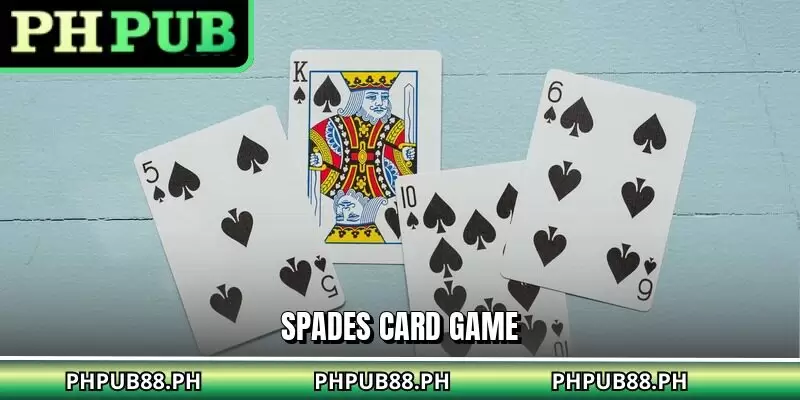
Spades card game is the classic partnership trick-taking game that requires sharp collaboration, disciplined bidding, and meticulous card counting to secure victory. PHPUB features competitive multiplayer tables for Spades game, offering players the chance to engage in deep strategic play.
Essential facts about spades card game basics
Essential facts about spades card game basics
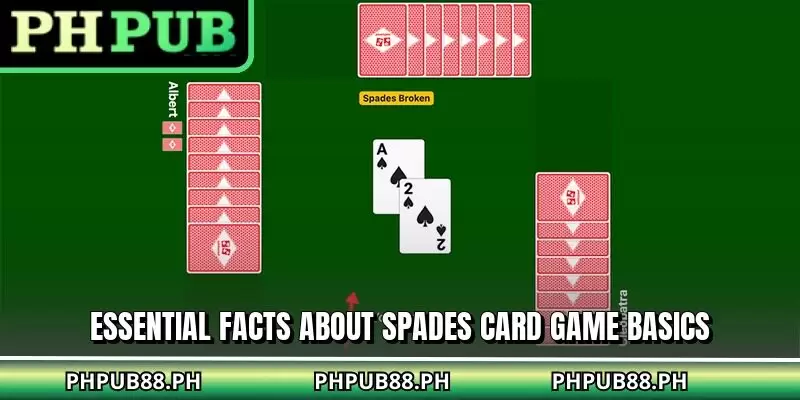
The Spades card game is defined by a fixed suit hierarchy where Spades always act as the trump suit, overpowering all other suits. This rule drives strategy, requiring players to track remaining trump cards and understand their distribution to manage risk effectively.
Another core element is partnership scoring, where teammates bid and score together based on expected tricks won. Success depends on coordination and trust, especially when attempting high-risk bids like Nil that can dramatically shift the score.
Mastering the core rules of the spades card game
Mastering the core rules of the spades card game
Successfully playing Spades card game requires precise bidding techniques, rigorous score tracking, and an understanding of the severe penalties associated with missing the contract or collecting too many sandbags.
The bidding phase and contract setting
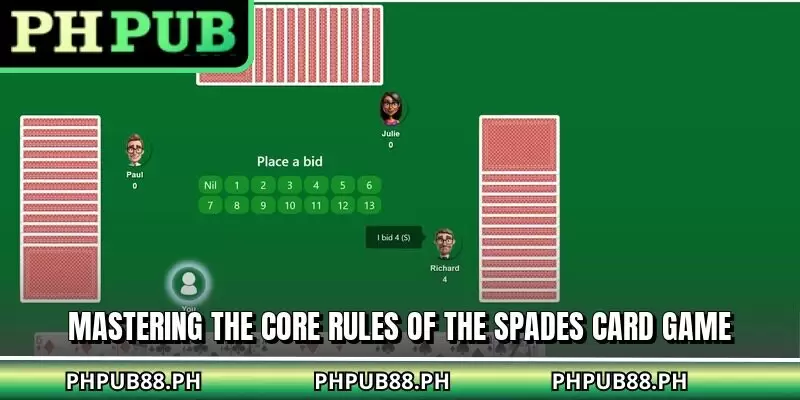
The bidding phase is the most critical element of Spades card game, where each player declares the number of tricks they guarantee their team will win based on the 13 cards dealt to them.
- Trick Count: Individual bids range from 0 (Nil) up to 13. The goal is to accurately assess your guaranteed winners. The team’s total contract is the sum of the partners’ individual bids (e.g., if Partner A bids 3 and Partner B bids 5, the team contract is 8).
- Scoring for Success: Successfully meeting the contract awards the team 10 points for every bid trick (e.g., winning 8 tricks on an 8-bid yields 80 points). Additionally, 1 bonus point is awarded for every trick taken over the contract.
- Consequences of Failure: If the team fails to meet the contract (e.g., winning only 7 tricks on an 8-bid), they lose 10 points for every bid trick (a painful 80-point penalty). This severe penalty necessitates conservative bidding when in doubt.
The nil bid (zero tricks)
The Nil bid is the high-risk, high-reward wager unique to Spades card game, requiring the player to declare they will win exactly zero tricks throughout the entire hand.
- Risk/Reward: If the Nil bid is successful (the player wins zero tricks), the team is awarded a substantial bonus (often 100 points, though this can vary by house rules). This massive bonus is frequently used to catch up when a team is significantly trailing.
- Penalty for Failure: If the player accidentally wins even one trick, they suffer a severe penalty (often 100 points, plus the partner’s contract penalty still applies). The risk of being set by an opponent’s low card is omnipresent.
- Strategic Timing: Nil bids are only viable when the player’s hand is extremely weak (no face cards, few or no Spades, and low-value cards in all suits), making it a calculated risk for a massive point swing, particularly in the later stages of a tournament.
Sandbagging and the ten-trick penalty
The “sandbagging” rule is designed to punish teams who consistently bid too low and win many tricks over their contract, enforcing bidding discipline in Spades game and preventing teams from coasting on safe, low bids.
- Definition: Every trick taken over the contract is recorded as an “overtrick” or “bag.”
- Penalty System: Once a team accumulates 10 bags, they suffer a heavy 100-point penalty, and their entire bag count resets to zero. For instance, if a team has 9 bags and wins 3 overtricks, they score 3 bonus points, immediately incur a -100 point penalty, and reset to 2 bags. This punitive system forces teams to bid accurately.
| Bid Type | Goal | Payout (Success) | Penalty (Failure/Sandbag) |
| Standard Bid (e.g., 5) | Meet the contract (win exactly 5 tricks). | 50 points (+1 per overtrick). | -50 points (if contract missed). |
| Nil Bid (0) | Win zero tricks. | +100 points (Solo). | -100 points (if 1 or more tricks won). |
| Overtricks (Bags) | Tricks won over contract. | 1 point per trick. | -100 points (for every 10 bags accumulated). |
These mechanics ensure that success in the Spades card game requires a delicate balance between aggressive bidding for points and conservative play to avoid the severe sandbag penalty, making the game far more intricate than simple luck.
The key to becoming a master of spades card game action

The key to becoming a master of spades card game action
Sustained success in the Spades card game depends on precise bidding, smart card management through accurate counting, and subtle partner coordination based solely on cards played.
Players must anticipate both partner and opponent behavior while tracking key Spades and high-value cards throughout each hand. Applying these strategic principles reduces volatility and improves long-term performance in Spades wagering.
The discipline of honest and analytical bidding
The most fundamental tactic is bidding honestly based on a cold, calculated assessment of your hand strength, counting only your guaranteed winners (Aces, King-Queen pairs, and high Spades after opponents’ Spades have been accounted for).
The strategic advice is to under-bid by exactly one trick if your hand is border-line (e.g., bid 4 when you estimate 4 or 5 tricks). This conservative approach is justified because the penalty for failing the contract is significantly worse than the -100-point sandbag penalty (which occurs over multiple rounds). Always round down guaranteed tricks for safety.
Strategic management of the sandbag rule threshold
Always monitor your team’s bag count displayed on the score sheet. Once your team is approaching the 8 or 9 bag threshold, the tactical imperative is to deliberately “dump” potential winning cards (especially low Spades or guarded Kings) on subsequent rounds.
For example, if you know you have the winning card for a trick, play a low card instead, deliberately forfeiting the trick to an opponent to avoid collecting the tenth sandbag and the inevitable 100-point penalty.
The art of forcing the opponent’s trump
An advanced tactic in Spades is forcing opponents to spend their high trump cards early. This is done by repeatedly leading strong non-Spade suits, such as Aces or Kings, even if it costs you a trick.
By doing so, opponents must choose between wasting low Spades early or risking their high Spades later. This clears the way for your remaining Spades to win clean tricks in the final phase, making careful trump counting essential throughout the hand.
Conclusion
Spades card game is a deeply strategic trick-taking challenge that rewards analytical bidding, precise partner communication, and strict penalty avoidance. PHPUB provides the competitive platform necessary for serious play. By mastering the Nil bid calculation, disciplined sandbag management, and the art of non-verbal card communication, you gain a significant advantage.
 Ninja Fruits – The Best PHPUB Tricks For Lucky Spins
  Midnight Thirst – Discover Hidden PHPUB Gems Right Now
  Iron Hero – How To Dominate The PHPUB Aquatic World
  Fire Joker Blitz – Discover The PHPUB Lucky Streak
  EVO Fantan Live – The PHPUB Strategy No One Tells You
  Epic Treasure 2 – Find Hidden PHPUB Gold On The Seas