
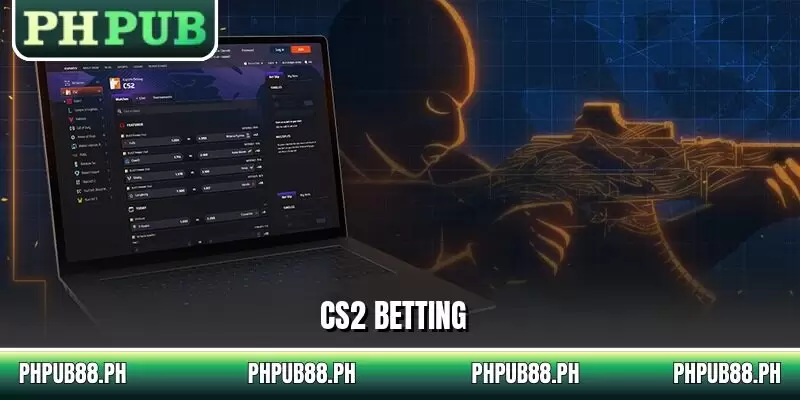
CS2 betting offers a highly analytical and financially rewarding esports market, uniquely dependent on team coordination, precise aim, and meticulous economic management. PHPUB provides extensive betting lines across all major global tournaments and leagues, attracting players who thrive on competitive tactical depth.
Quick insights into the fundamentals of CS2 betting
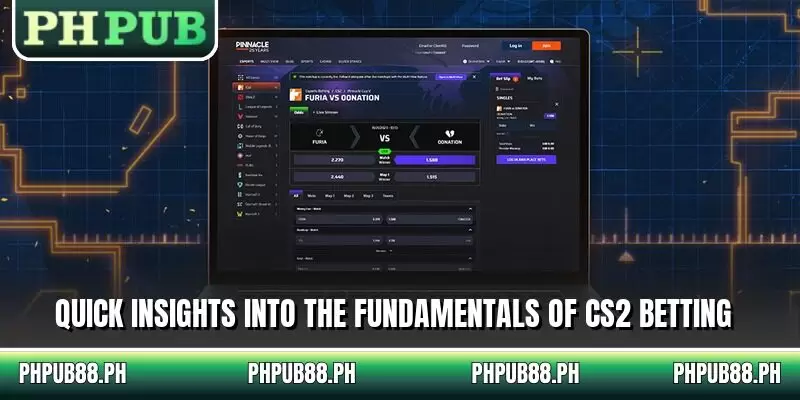
Quick insights into the fundamentals of CS2 betting
The high volatility that defines CS2 betting primarily stems from the game’s strict economic cycles and the pivotal nature of the first two rounds of each half.
Losing a single ‘pistol round’ can put a team at an economic disadvantage for up to four subsequent rounds, known as ‘eco’ or ‘force-buy’ rounds. This domino effect makes the start of every half hugely predictive of the total map score.
A fascinating structural element of CS2 betting is the importance of team-specific T-side (Terrorist) versus CT-side (Counter-Terrorist) win rates. Some teams consistently dominate the defensive CT-side but struggle to execute successful site takes on the T-side, creating a predictable statistical weakness
Simple guide to the core markets in effective CS2 betting

Simple guide to the core markets in effective CS2 betting
Successful wagering on CS2 betting requires mastery of the fundamental betting formats, which align with the game’s round-based structure and tournament format (Best-of-3 maps).
Match winner (series moneyline)
This is the simplest form of CS2 betting, requiring a prediction of which team will win the overall Best-of-3 (BO3) or Best-of-5 (BO5) match series.
- Odds Display: Typically displayed as decimal (e.g., 1.50) or American (e.g., -200).
- Strategy: Used for long-term predictions, where overall team form and tournament motivation are the primary factors.
Map winner and map handicap
These are the most popular markets, offering granular betting opportunities based on map-by-map performance.
- Map Winner: Betting on which team wins a specific map (e.g., Map 1: Inferno). The score is usually first to 13 rounds.
- Map Handicap: Betting on a team to win a map with a virtual round advantage or disadvantage (e.g., -3.5 rounds). This is a great market for betting against a clear favorite, requiring them to win convincingly.
Total rounds (over/under)
The Total Rounds market requires predicting whether the final score of a single map will be Over or Under a line set by the bookmaker (e.g., Over 21.5 rounds). This market focuses on the predicted competitiveness of the match.
- Over: Used when the match is predicted to be a close battle requiring multiple comebacks, pushing the score past the default line (e.g., 13-10 or 14-11).
- Under: Used when one team is highly favored and is expected to win quickly with a dominant score (e.g., 13-5 or 13-7).
| Market Type | Core Prediction | Volatility/Frequency | Strategic Focus |
| Match Winner | Series Outcome | Low (Overall form) | Team’s historical BO3 record. |
| Map Handicap | Margin of Victory | Medium | Team’s T-side/CT-side specialty. |
| Pistol Round Winner | First 2 rounds | Extreme | Player aim consistency (short term). |
| Total Rounds | Map Length | Medium | Team’s ability to win ‘eco’ rounds. |
Unique round-based prop bets
Prop bets offer high volatility on specific in-game events, often focused on the economic implications of the round.
- Pistol Round Winner: Betting on which team wins the very first round of the half, where only pistols are affordable.
- First Blood: Predict which team achieves the first kill in the entire map.
Maximizing gains with smart CS2 betting strategies

Maximizing gains with smart CS2 betting strategies
Success in CS2 betting is fundamentally driven by tactical intelligence regarding the game’s economic structure, demanding disciplined management and specialized analytical focus.
The competitive landscape of professional esports requires rigorous pre-match analysis and swift adaptation; applying these tactics mitigates risk and identifies key value spots in betting.
Mastering the economic cycle analysis
The most crucial tactic is analyzing the in-game economy, particularly after a pistol round win. A team that wins the pistol round is highly likely to win the next two or three rounds (‘anti-eco’).
The strategic move is to bet on the pistol round winner to win the map, or bet on the losing team to lose the subsequent rounds heavily, often betting the handicap against them.
Exploiting map pool weaknesses
Professional teams rarely excel on all seven maps in the active map pool. The tactical advice is to specialize your research into the map pool and identify the teams with glaring win-rate disparities (e.g., Team A having a 70% win rate on Inferno but only 35% on Nuke).
Betting against a strong team when they enter their weakest map is a classic value signal in CS2 betting.
Analyzing t-side vs. ct-side specialization
Teams possess deep, measurable differences in performance when playing on the T-side (attacking) versus the CT-side (defending).
The strategy dictates focusing your wager on the outcome of the first half (12 rounds) based on which side the team starts on. Bet on the team with the superior CT-side defense to win the first half outright if they start on that side, as defense generally holds a slight statistical advantage.
Strategic use of in-play betting during force buys
A ‘force buy’ occurs when a team has lost the previous round but lacks the funds for a full rifle buy, forcing them to purchase inferior weapons (SMGs or low-tier rifles). This is a vulnerable period.
The tactical advice for in-play CS2 betting is to bet heavily on the opponent to win the force-buy round, exploiting the temporary but predictable economic imbalance.
Bankroll segmentation by market volatility
Treat the Pistol Round Winner market as high volatility and the Match Winner market as low volatility.
Implement a segmented bankroll strategy where you allocate a very small unit (e.g., 0.5%) to the high-variance pistol rounds and reserve larger, more substantial units (e.g., 2%) for the low-variance Match Winner market where deep statistical analysis holds more predictive power.
Conclusion
CS2 betting rewards deep tactical and economic understanding, offering a complex yet highly rewarding esports market. PHPUB provides the necessary live data feeds and comprehensive odds for this challenging environment. Success is achieved by rigorous economic cycle analysis, exploiting map pool advantages, and disciplined unit sizing across various markets.
 Ninja Fruits – The Best PHPUB Tricks For Lucky Spins
  Midnight Thirst – Discover Hidden PHPUB Gems Right Now
  Iron Hero – How To Dominate The PHPUB Aquatic World
  Fire Joker Blitz – Discover The PHPUB Lucky Streak
  EVO Fantan Live – The PHPUB Strategy No One Tells You
  Epic Treasure 2 – Find Hidden PHPUB Gold On The Seas